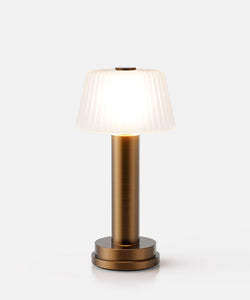
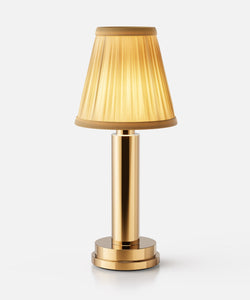
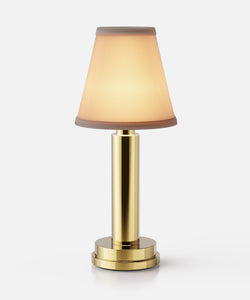
Located within The Quad, a design-conscious redeveloped precinct in uptown Dallas, Mamani is a distinctive restaurant and bar designed by New York’s Bryan O’Sullivan Studio. Drawing on the energy of the Riviera, the restaurant translates that influence into a space that unfolds through a sequence of distinct settings, from the main dining room to the bar and terrace, each defined by its own tone while remaining visually connected. At the tables, the NEOZ Victoria in Aged Brass brings a warm, controlled glow that sits comfortably within the composition, supporting the mood without drawing focus.
The project was led by Managing Director José Rodríguez, whose experience across hospitality and residential work reflects a careful balance between architectural discipline and the more intuitive aspects of how a space is occupied and understood. We spoke with José to discuss the thinking behind Mamani and how the studio approaches atmosphere, movement, and lighting as part of a cohesive whole.

NEOZ Victoria in Aged Brass at Mamani, Dallas. All photos by William Jess Laird.
Mamani draws on the spirit of the French and Italian Riviera. How do you avoid falling into familiarity and instead create something that feels distinctive?
It was important for our studio to design a contemporary space for a new restaurant for young restaurateurs. As is common in our practice, we looked at every aspect of the design with an eye towards distilling design references into a fresh design that is conceptually, but not literally, tied to precedents. Our goal was for the clientele to have a feeling of the Riviera, rather than to experience a 'theme'.
What were the key decisions that shaped the atmosphere of Mamani? How did you define and design for that?
Our clients had a strong inclination towards a layout that would “transport” guests. They were adamant that each of the areas—the main dining room, the bar, the private dining room, and the terrace—would have fairly distinct identities, even as all these spaces flow into one another. This enabled us to create a narrative that transports guests to an “idea” of a place, whether that’s St Tropez on the terrace or an Italian speakeasy at the bar.
We are very architectural in our approach, which helps define the scale and proportion of the spaces before the decoration comes in. Spaces should hold up, to a degree, even without the decoration—otherwise, we would be veering into a version of set design, or “theatricality” as you put it. Our goal is to design spaces that feel grounded.

The Victoria's warm glow sits within the composition without drawing focus — precisely as José Rodriguez describes.
How does the team think about how guests move, gather, and spend time within the room?
That's something we consider across all our projects: how we, as individuals, would want to experience the space. It can be something as ephemeral as wanting to feel 'moody,' down to very practical questions like where you place your handbag while dining. It's important to think about transitions. For example, there's a curtain between the main dining room and the bar that is often left open. This allows for a clear flow between the two spaces, while also suggesting a more intimate, jewel-box-like space behind the curtain. Almost giving the bar a sense of exclusivity.
At what stage in the process does the team begin defining the lighting approach? Were there moments in the process where key decisions significantly shifted the direction of the space?
Lighting considerations begin immediately. The lighting at the table should provide a warm and subtle effect, almost as if it’s not there. It should not distract from the larger composition; when seated, the table lighting should feel effortless. Our early sketches included the lighting concept, and thankfully, the clients brought a lighting consultant on board right away to help guide us through the process.
We tend to define the quality of light for each space, at different times of day, through a combination of trial and error and accumulated experience—both from our own projects and from other well-considered F&B environments. It always begins with the client’s vision: do they expect guests to linger in a particular area? Is the desired atmosphere more casual, candlelit, or club-like?
There are also pragmatic considerations—for example, whether guests will be reading long menus—which all inform how lighting ultimately shapes the pace and energy of the space.

Each area at Mamani holds its own identity. The private dining room, framed in brass, reads as a space apart.
Your studio has chosen NEOZ lamps for a number of projects, from Claridge’s Restaurant to Mamani. What is it about cordless table lighting that continues to make it relevant in high-end dining environments?
NEOZ lamps are designed with a sense of refinement and grace, which is why we are drawn to them. They are beautifully simple fixtures that can integrate seamlessly into a wide range of dining concepts. They are also highly practical. It’s important for us to find a product, like NEOZ, that blends with our design vision without becoming a distraction.
When in Dallas
Mamani is located at 2681 Howell St, BU4, Dallas, TX 75204, United States
They are open daily from 5 pm till late.